
Last updated September 21, 2026
Full 25-point door and opener safety check with every visit - springs, cables, rollers, tracks, and your LiftMaster or Chamberlain opener included
You get a price before we start. It does not change when the truck arrives.
 Before
 After
After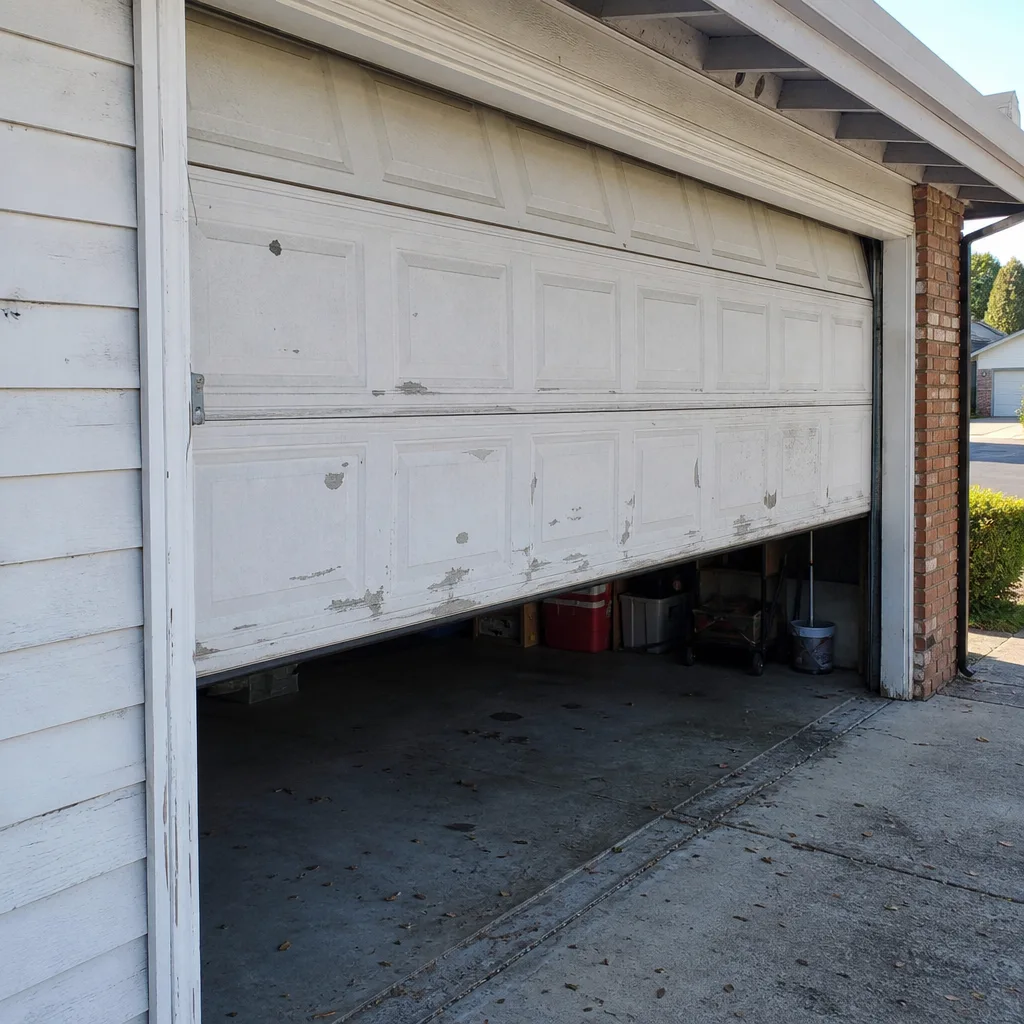 Before
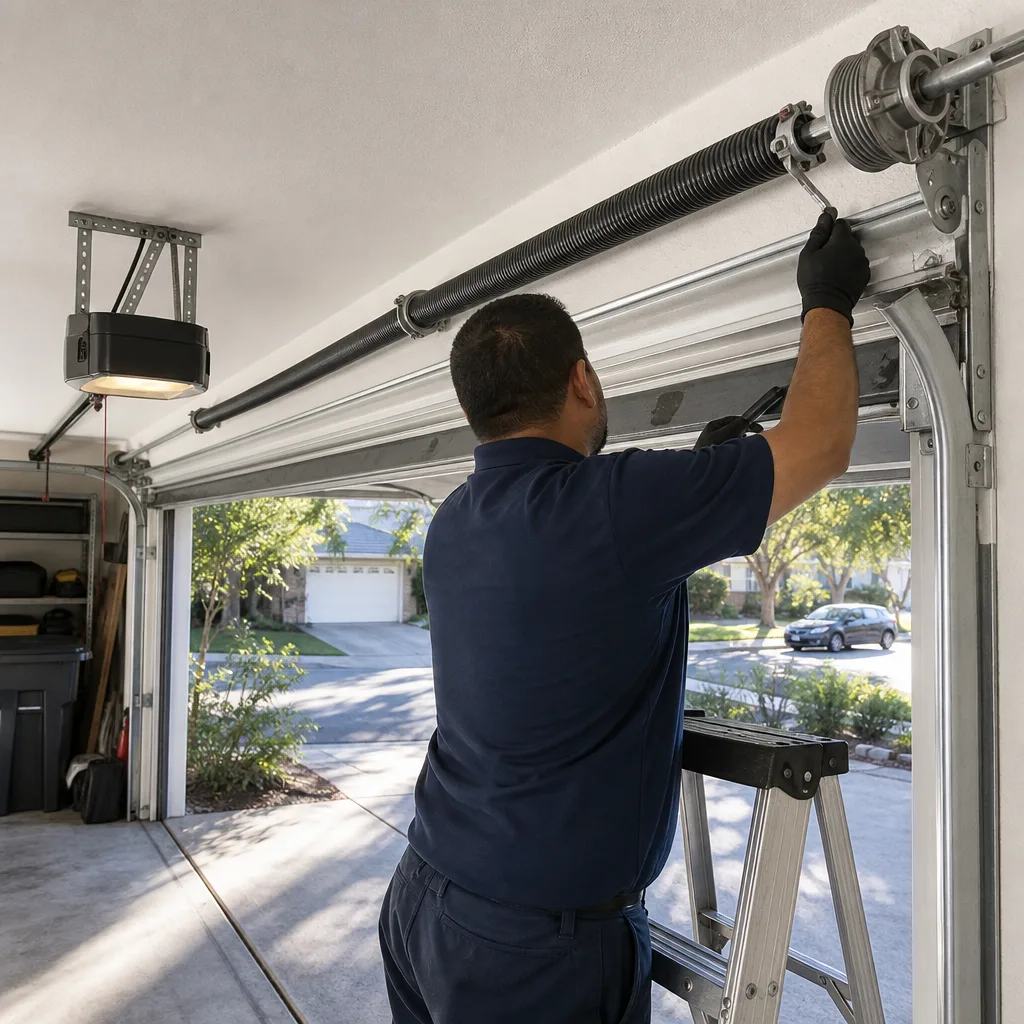 After
After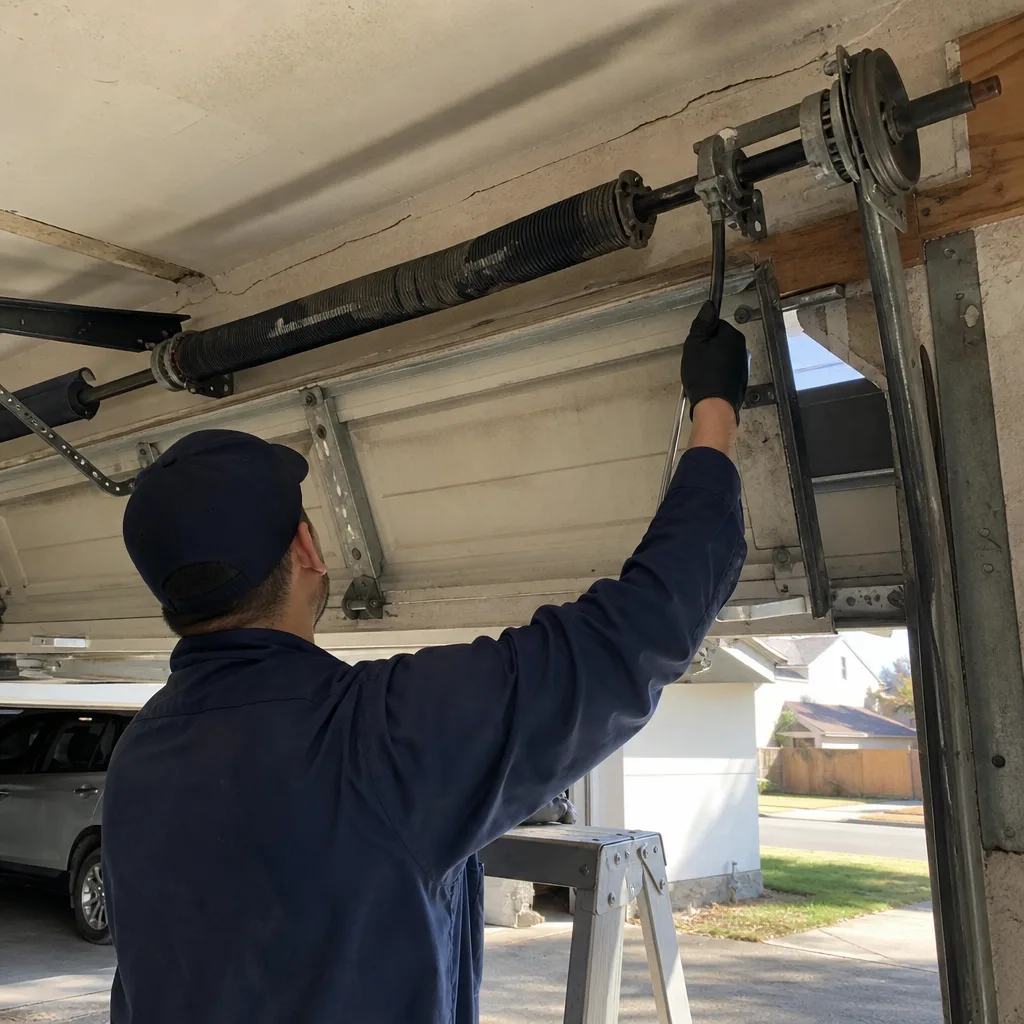 Before
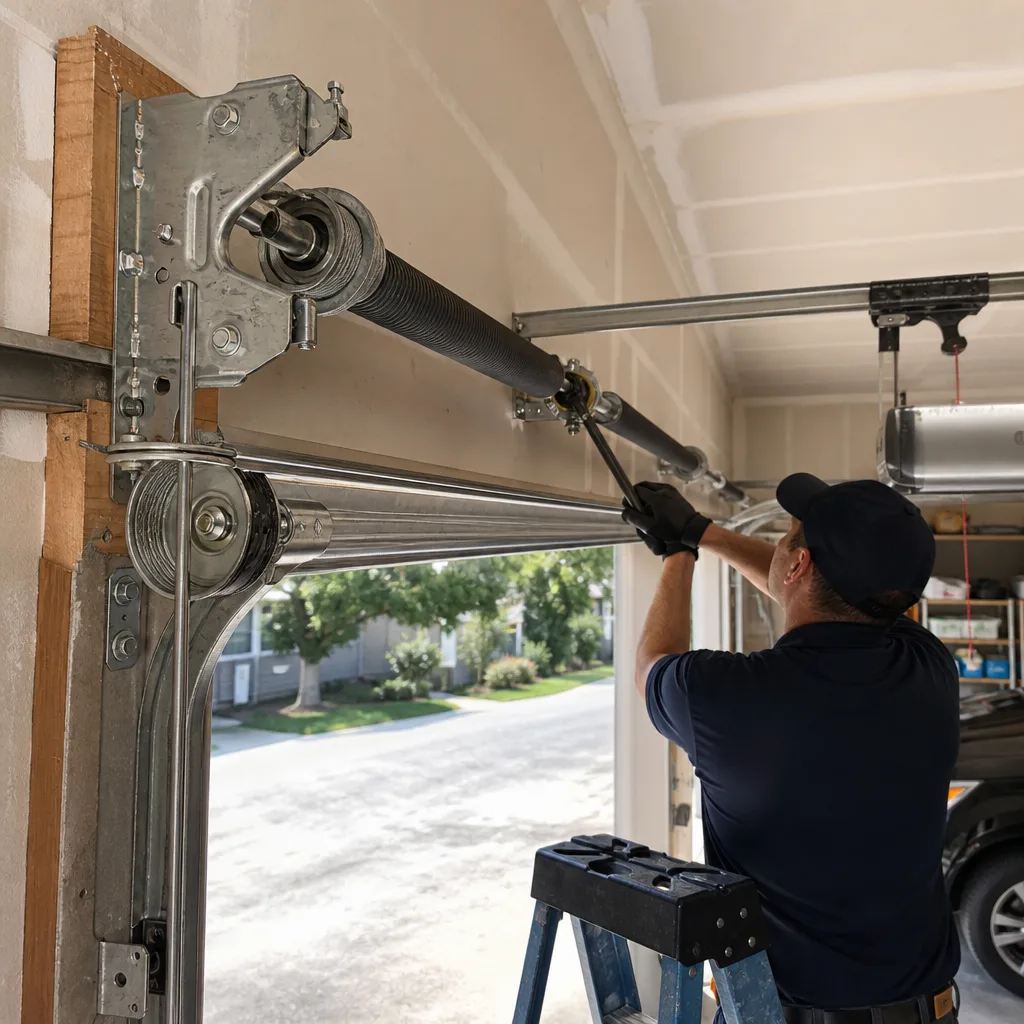 After
AfterGarage Door Warning Signs: A Pleasanton Homeowner’s Reference Guide
Here’s the problem with most warning sign guides: they tell you a garage door that reverses before hitting the ground and one that reverses after hitting the ground are the same “door reversal problem.” They’re not. The first is a photoelectric sensor issue, typically $120-$180 to fix. The second is a close-force limit misadjustment on the opener’s logic board, often $150-$220. Same symptom, different component, different cost, different safety urgency. In Pleasanton, where many homes in Ruby Hill, Kottinger Ranch, and Downtown were built during the 1985-2005 boom with original hardware now aging out, we’ve found that homeowners who can name the part that’s failing get faster diagnoses and more accurate quotes. This guide maps what you see and hear to the component behind it, the repair cost range in the Pleasanton market, and whether you need to stop using the door today or can schedule - or see our Complete Guide to Garage Door in Pleasanton for broader maintenance planning within the month.
Quick Answer
A garage door showing warning signs in Pleasanton typically needs repair within 0-30 days depending on the symptom. Grinding or scraping noises, slow operation, and intermittent reversal usually indicate worn rollers, track misalignment, or opener force settings ($120-$340). Broken springs, frayed cables, or doors that won’t stay open are safety stops - stop using the door immediately and call for same-day service ($180-$520). Most Pleasanton homeowners can safely perform visual inspection and basic testing; anything involving the torsion spring system, high-tension cables, or electrical diagnostics requires a trained technician. For help choosing one, read our How to Hire a Garage Door Contractor in Pleasanton: A Step-by-Step Guide.
Table of Contents
- Sound-Based Diagnosis: What Each Noise Means
- Movement-Based Diagnosis: Slow, Fast, or Uneven
- Visual Inspection Points Homeowners Miss
- The Immediate-Stop List: Safety Issues That Shut Down Use Today
- The Schedule-Soon List: Monitor and Book Within 30 Days
- How to Photograph and Document Symptoms Before Calling
- Pleasanton-Specific Factors: Climate, Codes, and Common Hardware
- Common Mistakes to Avoid
 Before
 After
AfterSound-Based Diagnosis: What Each Noise Means
Noise is the most reported warning sign, and also the most misdiagnosed by homeowners because the same word - “grinding” - gets applied to three distinct failure modes. Here’s what we listen for on service calls across Pleasanton, from the older tract homes near Valley Avenue to the custom builds in Birdland.
Grinding Noise
A true grinding sound, like metal on metal without rhythmic interruption, usually points to worn rollers or a failing trolley carriage. The roller bearings have dried out or the trolley carriage (the component that travels along the opener rail, pulling the door) has stripped its internal gears. On steel rollers, we expect 8-12 years of service in Pleasanton’s dry climate; nylon rollers often go 12-15 years but develop flat spots that grind against the track.
Probable part: Rollers ($12-$18 each, full set $140-$220 installed) or trolley carriage ($85-$150 part, $160-$240 installed).
Safety urgency: Schedule-soon. A grinding roller won’t cause sudden catastrophic failure, but it will damage the track and eventually the door sections.
Popping Noise
A sharp pop, often heard at a specific point in the door’s travel, indicates dry hinges or a stressed torsion spring. The pop is the sound of metal overcoming static friction - a hinge pin binding, or a coil in the torsion spring slipping past its neighbor as the spring loses tension uniformity. In Pleasanton, where summer temperatures regularly hit 95°F and winter nights drop to 38°F, thermal cycling accelerates hinge drying and spring fatigue. Our Seasonal Garage Door Care for Pleasanton: Year-Round Homeowner’s Guide covers how to time preventive maintenance to this climate stress.
Probable part: Hinges ($15-$35 each installed, or lubrication service $85-$120) or torsion spring ($180-$340 for standard residential, $280-$520 for high-cycle or dual-spring systems).
Safety urgency: Hinges are schedule-soon; a popping torsion spring is an immediate stop. A spring making noise before it breaks is giving you 1-4 weeks of warning. Use them.
Scraping Noise
A continuous scraping, like metal dragging against metal, means track misalignment or a bent track section. The door’s rollers are contacting the track wall rather than rolling freely within it. This often follows an impact - a basketball, a vehicle bumper, or the door catching on an object - but can also develop from loose track mounting brackets working free over years of vibration.
Probable part: Track realignment ($120-$180) or track replacement ($220-$380 per 8-foot section).
Safety urgency: Immediate stop if the door is visibly binding or leaving the track. Schedule-soon if the scrape is intermittent and the door completes its cycle.
Rattling or Vibrating
Loose hardware - nuts on the roller brackets, track lag screws, or opener mounting bolts - produces a rattling that amplifies through the door’s hollow sections. In the 1990s-era homes common in Pleasanton’s Pleasanton Valley and Mohr Park neighborhoods, we’ve found original hardware that has never been torque-checked in 25+ years.
Probable part: Hardware tightening and inspection ($85-$140). Often bundled with roller or hinge replacement.
Safety urgency: Schedule-soon, but don’t ignore it. Vibration loosens more hardware, and a detached opener mounting bracket can drop the opener assembly.
| Noise | Probable Component | Pleasanton Cost Range | Urgency |
|---|---|---|---|
| Grinding | Worn rollers or trolley carriage | $140-$240 | Schedule-soon |
| Popping | Dry hinges or stressed torsion spring | $85-$520 | Spring: immediate; hinges: schedule-soon |
| Scraping | Track misalignment or bent track | $120-$380 | Immediate if binding; schedule-soon if intermittent |
| Rattling | Loose hardware | $85-$140 | Schedule-soon |
Movement-Based Diagnosis: Slow, Fast, or Uneven
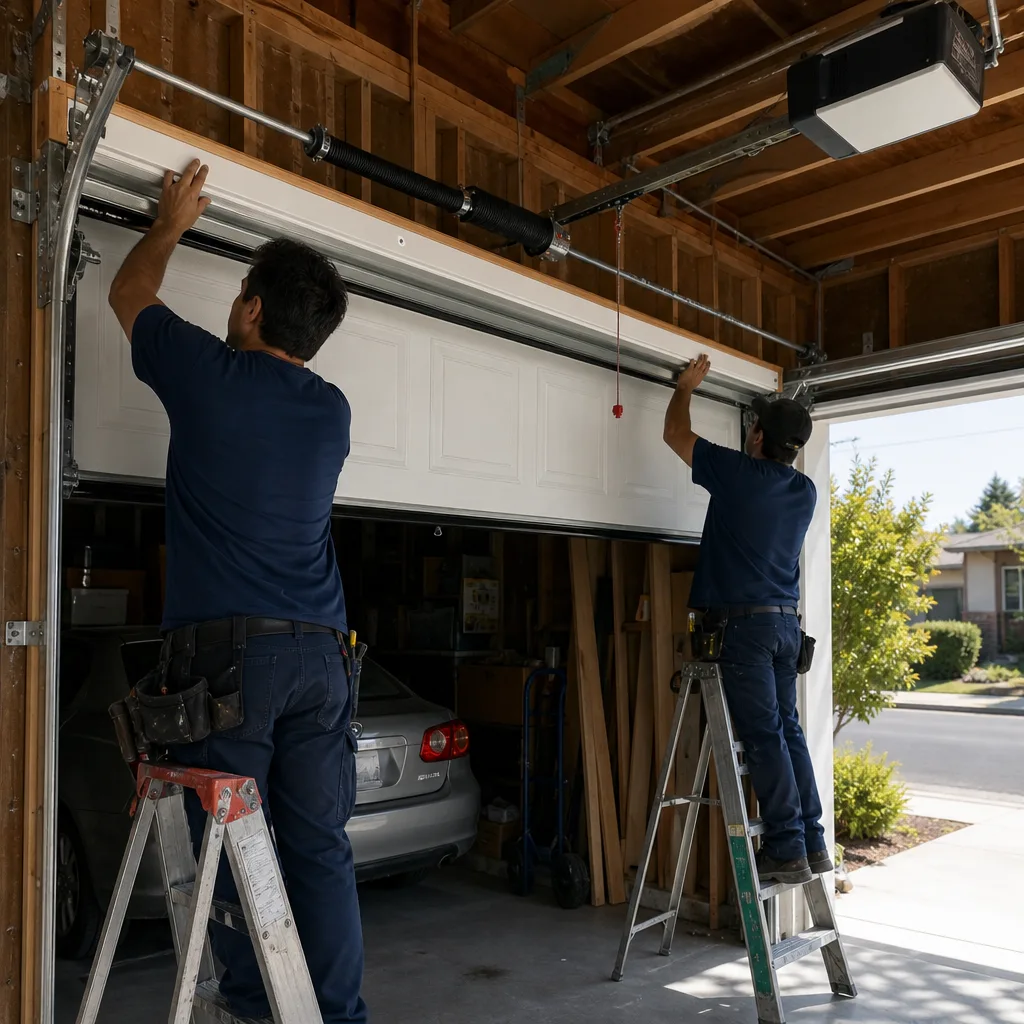
Speed and symmetry tell different stories depending on direction. Most guides miss this distinction entirely.
Slow on Open, Normal on Close
The door struggles to rise from the closed position but descends at normal speed. This indicates weakened torsion springs that can’t provide adequate counterbalance force. A standard 16×7 steel door weighs 150-180 pounds; the springs do 90% of the lifting. When spring tension drops, the opener’s motor works harder, overheats, and eventually fails.
We see this pattern frequently in Pleasanton’s Kottinger Ranch and Vintage Hills, where original doors from the 1980s-1990s still run on their first or second spring set. The dry climate here actually extends spring life compared to coastal humidity, but 15-20 years remains the practical limit for standard-cycle springs.
Probable part: Torsion spring replacement or tension adjustment ($180-$340 standard; $280-$520 high-cycle).
Safety urgency: Schedule-soon, but monitor closely. If the opener strains audibly or the door stops mid-travel, stop using it.
Slow on Close, Normal on Open
The door descends sluggishly but rises normally. This is rarely a spring issue. More commonly, it’s excessive friction in the track system (dirty or damaged rollers, bent track) or a close-force setting on the opener that’s been adjusted upward to compensate for other problems. The opener’s logic board monitors motor current; when resistance exceeds the programmed threshold, it slows or reverses.
Probable part: Roller/track service ($120-$220) or opener force-limit recalibration ($85-$150). If the force limit was manually adjusted by a previous technician, that adjustment may mask an underlying mechanical issue.
Safety urgency: Schedule-soon. A door that closes slowly due to high resistance is a safety hazard - the auto-reverse may not trigger correctly if the resistance pattern is irregular.
Uneven Movement: One Side Higher Than the Other
The door rises or descends with a visible tilt, one side leading by 2-6 inches. This indicates a broken spring in a dual-spring system, a slipped cable drum, or a seized roller on one side. On single-spring doors (common on 8-foot-wide openings), this pattern means the cable has come off the drum or the drum itself has rotated on the torsion tube.
Never operate a door showing uneven movement. The remaining cable is under extreme asymmetric load and can whip free, causing serious injury or property damage.
Probable part: Cable and drum service ($160-$280) or spring replacement with cable reset ($240-$420).
Safety urgency: Immediate stop. This is non-negotiable.
Jerky or Stuttering Movement
The door moves in fits and starts, pausing briefly then continuing. This can indicate a failing opener motor with worn brushes, a damaged logic board with intermittent relay contact, or - most commonly - a trolley carriage that’s partially stripped and catching on undamaged gear teeth.
On Garage Door Opener Repair & Installation in Pleasanton calls, we test this by disconnecting the opener and running the door manually. If manual operation is smooth, the problem is in the opener, not the door system.
Probable part: Trolley carriage ($160-$240), logic board ($180-$320), or full opener replacement ($420-$780 installed for standard chain/belt drive).
Safety urgency: Schedule-soon. Jerky operation stresses door components and will accelerate their failure.
Visual Inspection Points Homeowners Miss
Most Pleasanton homeowners check the door panels and maybe the opener light. Here are the inspection points that reveal problems 6-12 months before they become emergencies. For additional walkthroughs, see our more guides & resources.
Cable Fraying at the Drum
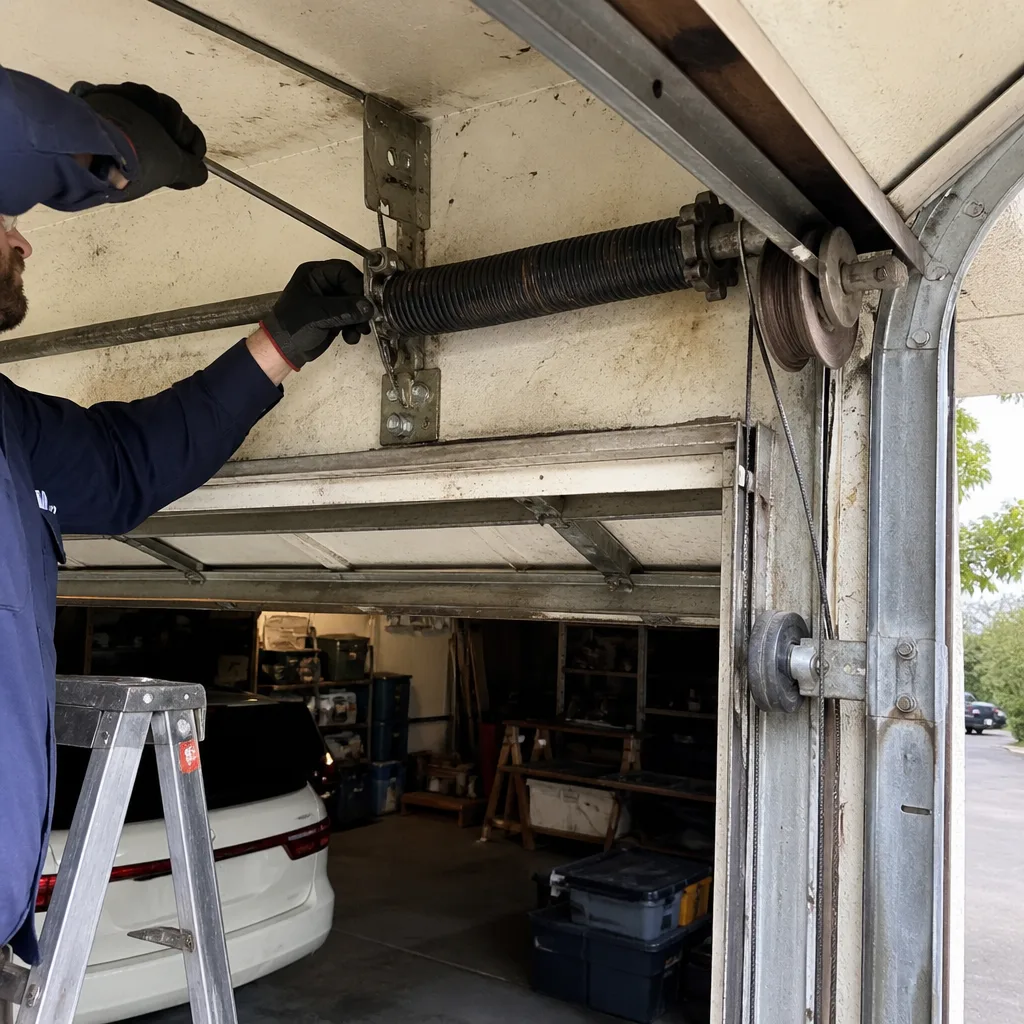
Stand inside your garage with the door closed. Look up at the cable drums mounted at each end of the torsion tube, just inside the end bearing plates. The cable wraps around the drum in a neat helix. Fraying appears as unwound strands, rust blooming, or a “bird’s nest” of loose wires near where the cable terminates in the drum notch.
Frayed cables fail without warning. We’ve replaced cables in Pleasanton’s Ruby Hill that showed minor fraying in March and complete separation by June. The replacement cost is $160-$280; an uncontrolled door drop from a failed cable can cost $2,000+ in panel, track, and vehicle damage.
Bottom Bracket Hardware
The bottom brackets connect the lifting cables to the door’s bottom section. These brackets are under constant tension - never attempt to loosen or remove them. What you can inspect: Are the bracket bolts present and tight? Is the bracket itself cracked or distorted? Does the cable show wear where it exits the bracket?
In our experience across Pleasanton, bottom bracket failure is rare but catastrophic when it occurs. The 365-Day Done Right Promise covers our bracket work because we torque-check these on every spring or cable job, per The Haven Standard.
Torsion Spring Winding Cones
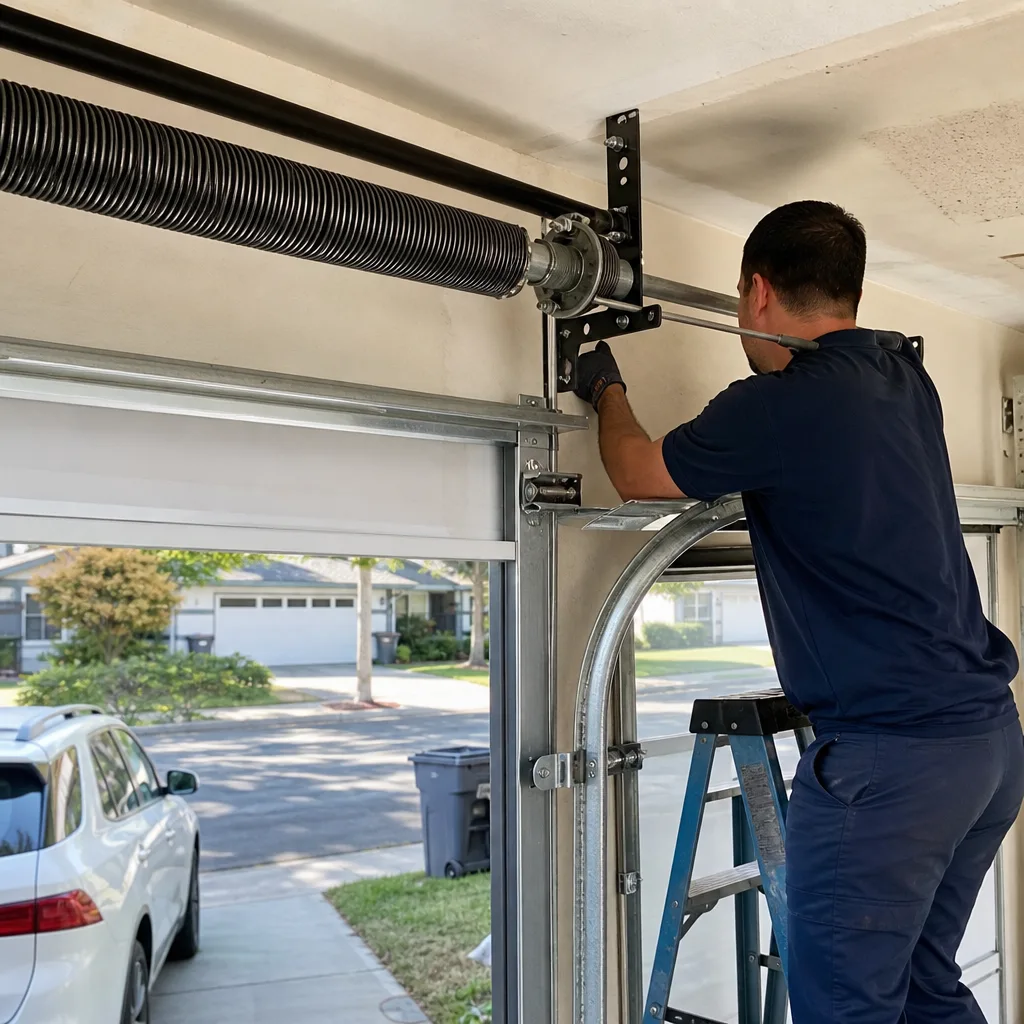
The winding cones are the hex-shaped fittings at each end of the torsion spring, where the spring mounts to the center bracket and the torsion tube. Look for:
- Cracks in the cone casting, especially at the set screw holes
- Evidence of the cone slipping on the tube (scratches, polished metal where the set screw bites)
- Gaps between the spring coils that are wider on one side than the other (indicates uneven tension and imminent failure)
Spring replacement in Pleasanton runs $180-$340 for a standard 10,000-cycle spring. High-cycle springs (25,000-50,000 cycles) run $280-$520 but last 2.5-5x longer - we typically recommend them for homes with attached garages that see 4+ cycles daily.
Track Mounting Bracket Integrity
The vertical tracks are held to the door frame by J-brackets or angle brackets with lag screws into the framing. In older Pleasanton homes with wood framing that’s dried and shrunk, these lag screws can work loose. Look for brackets that have pulled away from the frame, elongated screw holes, or shims that have fallen out.
Track bracket re-securing is typically $85-$140 as part of a larger service call. Left unaddressed, loose tracks allow the door to shift laterally, damaging rollers and sections.
Weatherstrip and Bottom Seal
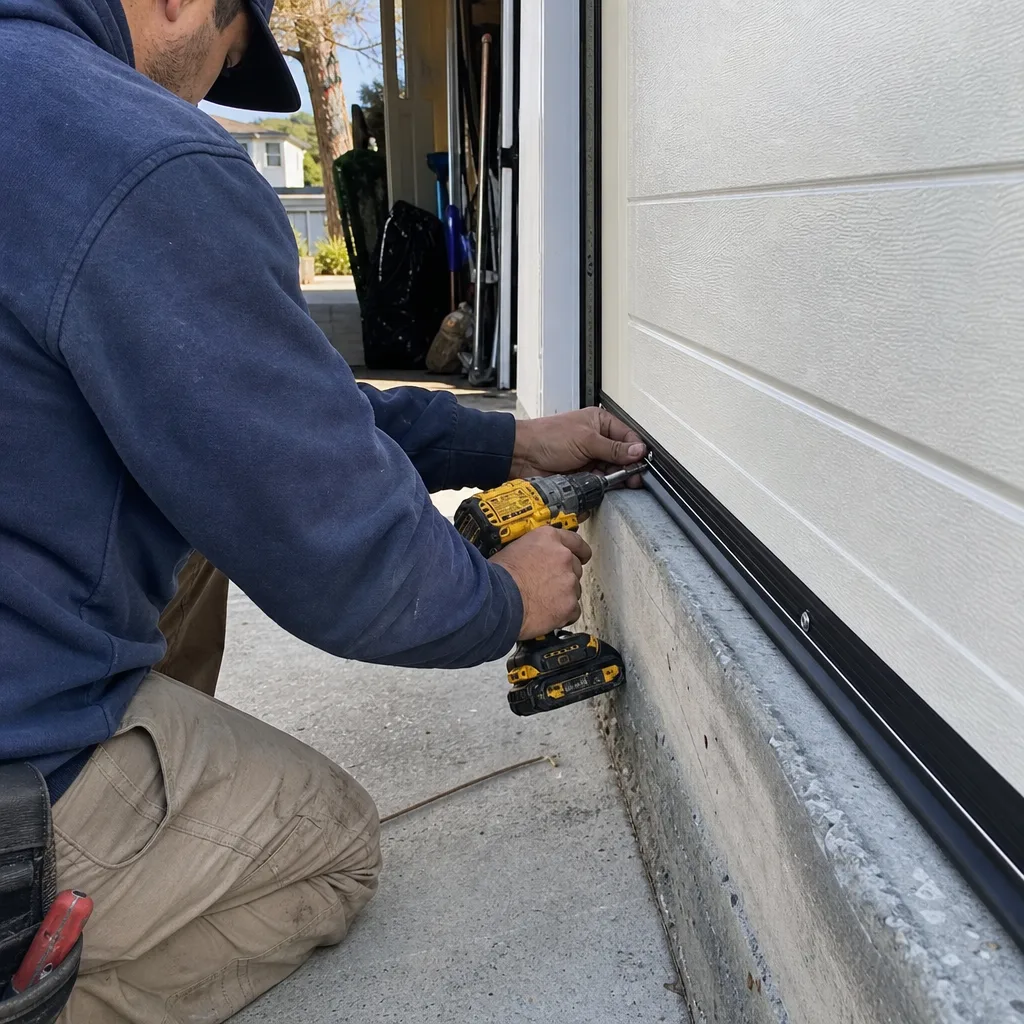
The rubber or vinyl seal at the door’s bottom edge and the vinyl flap seal on the exterior frame keep water, pests, and dust out of the garage. In Pleasanton’s dry summers, these seals become brittle and crack; winter rains then leak through. A deteriorated bottom seal also allows the door to sit unevenly on the floor, stressing the bottom section and brackets.
Bottom seal replacement: $45-$85 for T-style or bulb-type seals. Full perimeter weatherstrip: $120-$180.
The Immediate-Stop List: Safety Issues That Shut Down Use Today
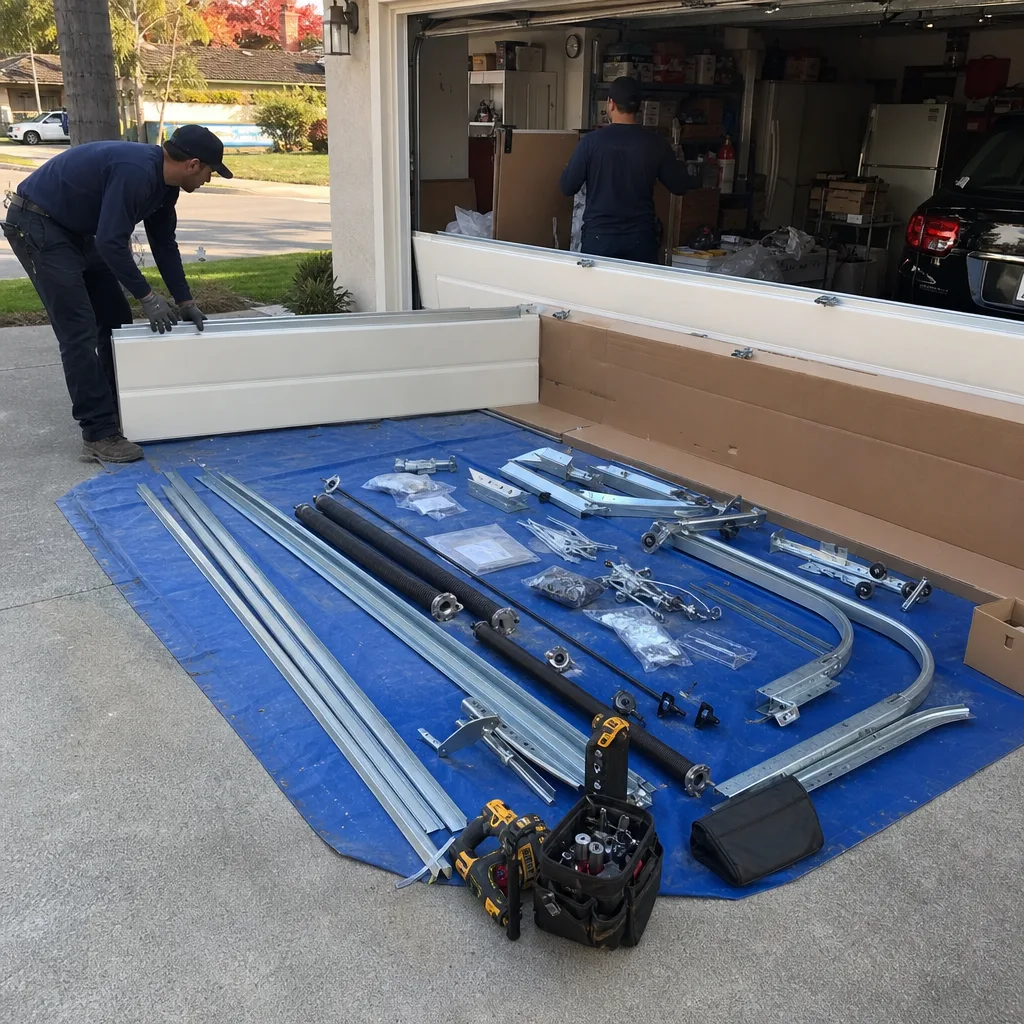
Some warning signs mean the door is actively dangerous to operate. Stop using it immediately. Unplug the opener if you have one. Do not attempt repair yourself on these items.
- Broken torsion spring. You’ll know by the loud bang, the 2-inch gap in the spring coil, and the door’s sudden dead weight. A 16-foot door with a broken spring weighs 150-180 pounds. The opener cannot lift it safely and will damage itself trying. Spring replacement: $180-$520 depending on size and cycle rating. Garage Door Parts in Pleasanton suppliers stock common sizes, but spring selection requires measuring wire diameter, inside diameter, and coil length - not a homeowner task.
- Frayed or separated lift cable. Any visible fraying with broken strands, or a cable that’s come off the drum, creates risk of uncontrolled door drop. Cable replacement: $160-$280.
- Door that won’t stay open. If the door drifts down from the open position, spring tension is critically low or a spring has broken in a dual-spring system. The door can close unexpectedly on a person or vehicle.
- Uneven movement with visible tilt. As described above, asymmetric loading risks cable whip and door collapse.
- Track separation or roller out of track. A roller that has left the track, or a track section that’s pulled away from the wall, means the door’s guidance system has failed. Continued operation will damage door sections and create falling hazard.
- Opener runs but door doesn’t move, with grinding from the motor housing. The opener’s main gear or sprocket has stripped. The motor is running unloaded, which can overheat and damage the logic board. Stop the opener to prevent secondary damage.
For any immediate-stop condition, Servo Garage Doors Pleasanton home provides same-day emergency service with a named technician and on-the-way text. Calls are answered by a live person, 24/7, including holidays.
The Schedule-Soon List: Monitor and Book Within 30 Days
These symptoms indicate wear that will progress to failure, but the door remains safe to operate with normal precautions. Book service within 30 days to prevent escalation and secondary damage.
- Grinding rollers or trolley carriage. The noise is abrasive wear in progress. Every cycle damages the track or opener rail further. Roller replacement: $140-$220. Trolley carriage: $160-$240.
- Intermittent photoelectric sensor reversal. The door reverses occasionally on close, especially in bright sunlight or when the sensors are dusty. Clean the lenses first; if the problem persists, the sensors may be misaligned or failing. Sensor replacement: $120-$180. Note: Chamberlain and LiftMaster sensors from 2011-2016 are prone to infrared LED degradation in high-heat environments like Pleasanton’s south-facing garages.
- Slow operation in one direction. As detailed above, typically spring weakening (slow open) or track/opener friction (slow close). Address before the opener fails from overwork.
- Remote or keypad intermittent response. Often the logic board’s radio receiver weakening, or interference from LED light bulbs installed in the opener housing. (Standard LED bulbs emit RF noise in the 315-390 MHz range used by most openers.) Diagnosis and repair: $85-$180; logic board replacement if needed: $180-$320.
- Weatherstrip deterioration. Not a safety issue, but water intrusion in winter damages stored items and can rust bottom door sections and hardware.
- Cosmetic panel damage with structural integrity intact. Dents or scratches that don’t affect door operation. Panel replacement is available for most Clopay and Amarr doors; cost varies widely by section size and insulation. Garage Door Installation in Pleasanton includes full panel replacement assessment.
How to Photograph and Document Symptoms Before Calling
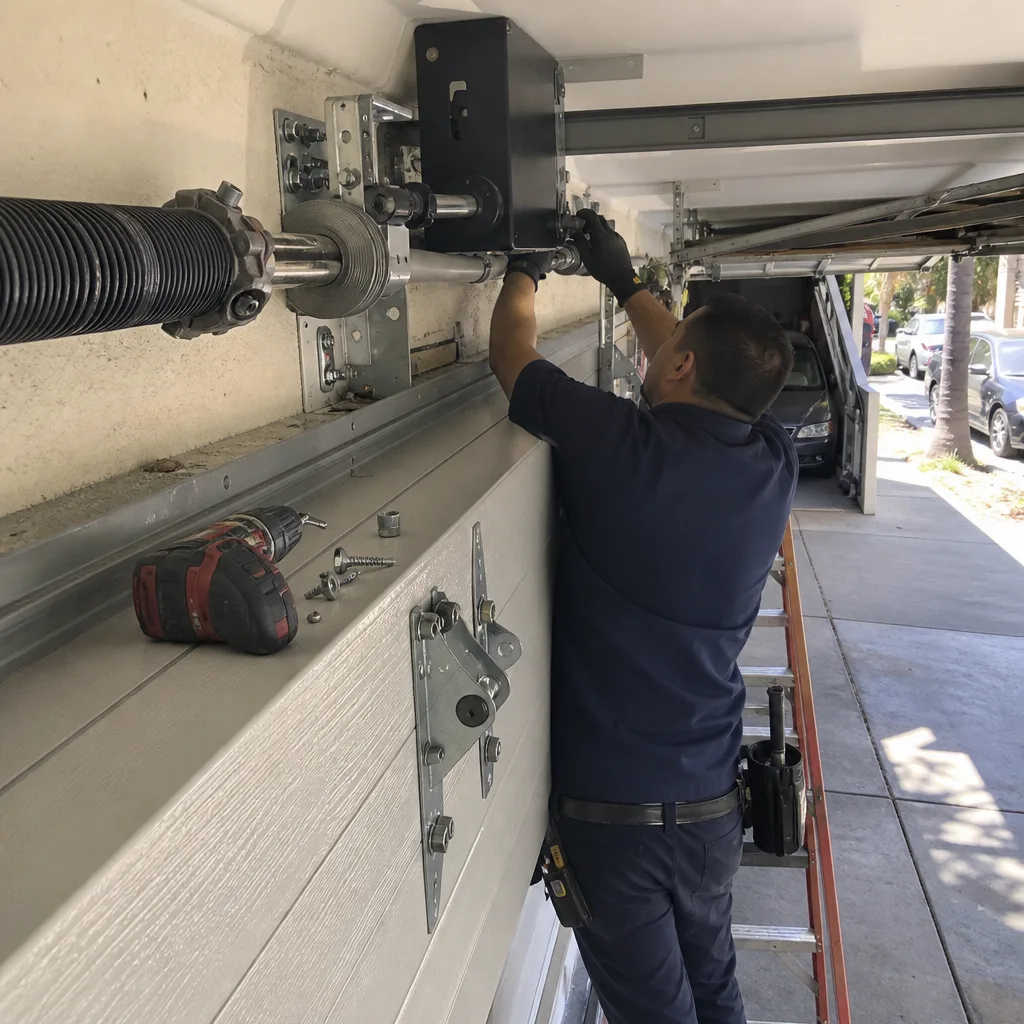
Clause 4 of The Haven Standard requires our technicians to photograph the failed component before quoting replacement. You can speed this process and improve quote accuracy by sending your own documentation before we arrive. Here’s what captures the information we need.
For Cable or Spring Issues
- Stand inside the garage, door closed, camera at chest height.
- Include the full width of the torsion assembly - spring, winding cones, and both cable drums - in a single frame if possible.
- Take a second close-up of any fraying, gap, or crack, with the camera flash on to highlight surface texture.
- For spring gaps, place a ruler or known object (standard business card: 3.5 inches) in frame for scale.
- Photograph the door from the side, closed, to show cable position on the drum.
For Track or Roller Issues
- With the door at the problem position (usually mid-travel), photograph the roller in the track from inside the garage.
- Include the track mounting bracket and its attachment to the wall framing.
- If the track is visibly bent, photograph it with a straight reference - the edge of a level, or the vertical track section above the bend.
For Opener or Control Issues
- Photograph the opener manufacturer’s label (usually on the side or back of the motor housing) showing model number and date code.
- Photograph the wall control panel and any error code displayed.
- For intermittent issues, note the time of day, weather conditions, and whether the problem occurs with the remote, keypad, or wall button - or all three.
Send these to us when you call (510) 398-4466. Our technician arrives with part research already done, and your written quote reflects actual observed conditions, not a flat-rate guess.
Pleasanton-Specific Factors: Climate, Codes, and Common Hardware
Pleasanton’s location in the Amador Valley creates conditions that affect garage door longevity differently than coastal Bay Area cities.
Thermal Cycling and Spring Life
Summer highs of 95-105°F and winter lows of 35-40°F produce 60-70°F daily swings during shoulder seasons. Torsion springs fatigue through thermal expansion stress as well as load cycles. In our records, Pleasanton springs average 12-16 years for standard-cycle units, slightly below the 15-18 year national average for moderate climates. High-cycle springs (25,000+ cycles) narrow this gap by using thicker wire and more conservative stress ratios.
Wind Load and Code Requirements
Pleasanton falls within Alameda County’s wind exposure zone B (basic wind speed 85 mph, 3-second gust). Garage doors must meet ASTM E330 structural performance standards for this zone, but most residential installations from the 1990s-2000s were not wind-rated. If you’re replacing a door today, current code requires a labeled wind load rating - typically 20 PSF for this zone - which affects track gauge, reinforcement strut placement, and hardware selection. A Garage Door Installation in Pleasanton assessment includes code compliance verification.
Common Original Equipment
Homes built during Pleasanton’s major growth periods (1985-1995 and 2000-2008) typically have:
- Clopay or Amarr steel raised-panel doors, 25-gauge or 24-gauge, often uninsulated or with 1⅜-inch polystyrene backing
- Genie or Chamberlain chain-drive openers, ½ HP, with safety beam retrofit on pre-1993 installations
- Standard-cycle torsion springs (10,000 cycles), now at or beyond design life
The Genie screw-drive openers common in 1990s Pleasanton tracts are now 25-30 years old. Parts availability is limited; we typically recommend replacement with a current belt-drive model rather than chasing obsolete components.
HOA and Architectural Review
Several Pleasanton neighborhoods, including Ruby Hill and certain Kottinger Ranch phases, require architectural review for door replacements that change color or style. We provide product cut sheets and color samples for HOA submission as part of our installation process. The written scope in your quote specifies the exact model, color, and glass option - documentation that satisfies most review boards without revision cycles.
Common Mistakes to Avoid
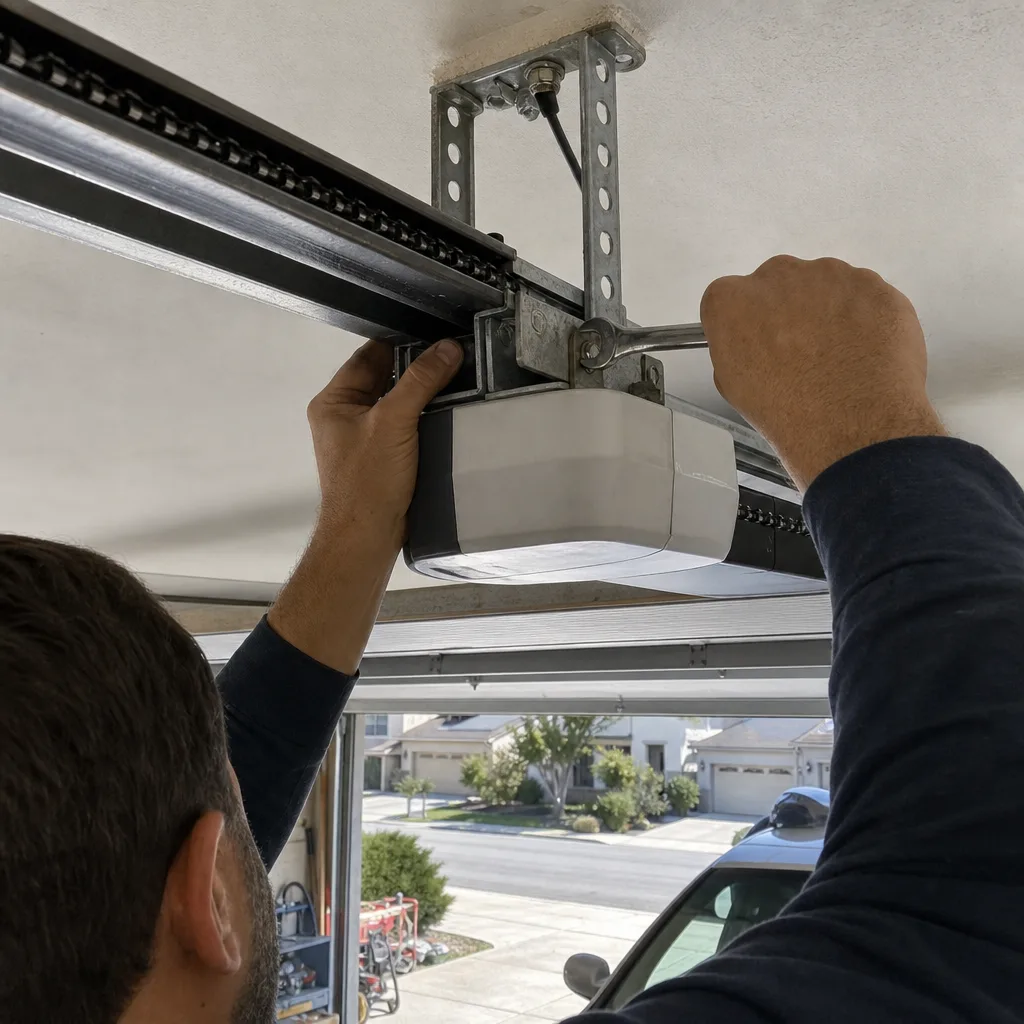
- Ignoring a “small” popping noise. In Pleasanton’s dry climate, hinge pins dry out in 18-24 months without lubrication. The pop is metal welding itself to metal under load. Left alone, the hinge seizes, the roller binds, and the door section twists - turning a $35 hinge into a $400 panel replacement.
- Adjusting opener force limits to compensate for mechanical problems. When a door moves slowly, some homeowners or inexperienced technicians increase the opener’s close-force setting. This overrides the safety reverse system and can crush an obstruction. The correct fix is mechanical: springs, rollers, or track. The opener’s force limits are calibrated at installation and should not be changed without testing the door’s balance first.
- WD-40 on rollers or springs. WD-40 is a solvent and water displacer, not a lubricant. It strips existing grease and attracts dust, creating abrasive paste. Use a lithium-based garage door lubricant or silicone spray on hinges, rollers, and springs. Never lubricate the track itself - the rollers need friction to roll rather than slide.
- DIY spring or cable work. Torsion springs store 1,000-1,500 foot-pounds of energy. Winding cone set screws require specialized winding bars (not screwdrivers or pliers). Every year, emergency rooms in the Tri-Valley treat homeowners for lacerations, fractures, and ocular injuries from spring or cable failures during amateur repair. This is not a cost-saving opportunity; it’s a trained-technician-only repair.
- Replacing the opener without checking door balance. A door that’s 20 pounds heavy will destroy a new opener in 2-3 years. We test balance on every opener job - disconnect the opener, lift the door manually to mid-travel, and verify it stays put. If it drifts, we fix the springs first. The Haven Standard requires this sequence; skipping it voids our 365-Day Done Right Promise on the opener.
- Waiting for “both springs” to break. Dual-spring systems are designed so one spring can temporarily support the door if the other fails. This is a safety margin, not a design feature. Operating on one spring overloads the remaining spring, damages the opener, and risks asymmetric cable loading. Replace springs in matched pairs.
When to Call a Professional
Call a trained technician for any immediate-stop condition, any work involving torsion springs or lift cables, any electrical diagnosis beyond breaker checking, and any situation where you’ve documented symptoms but can’t identify the component. In Pleasanton, Servo Garage Doors Pleasanton offers free estimates with flat, written pricing before any work starts - Clause 1 of The Haven Standard. Emergency calls are answered by a live person at (510) 398-4466, 24/7, with a named technician and on-the-way text. We photograph what we find, quote what we photograph, and document what we do. Every time.
Frequently Asked Questions
Most common repairs in Pleasanton range from $120 for sensor realignment to $520 for high-cycle dual spring replacement. Roller sets run $140-$220, cable and drum service $160-$280, and opener repairs $85-$320 depending on component. We provide a flat, written price before any work starts - no exceptions. Call (510) 398-4466 for an exact quote; estimates are free.
Yes, for hinges, rollers, and springs - use a lithium-based garage door lubricant or silicone spray, applied lightly every 12 months. Do not lubricate the track. Do not use WD-40. Never attempt to lubricate or touch the torsion spring while it’s under tension; the winding cones and set screws are hazardous even when the door is closed. If you’re unsure which components are safe to approach, schedule a maintenance visit and we’ll show you.
This is a photoelectric sensor issue, not a close-force problem. The sensors mounted 4-6 inches above the floor on each side of the door opening are misaligned, obstructed, or failing. Check for dust, spider webs, or objects blocking the beam. If cleaning doesn’t resolve it, the sensors may need realignment ($85-$120) or replacement ($120-$180). Direct sunlight into a south- or west-facing garage can also blind infrared sensors - we install sun shields or relocate sensors when this occurs in Pleasanton’s sun-exposed homes.
Standard 10,000-cycle torsion springs last 12-16 years in Pleasanton’s climate, slightly below national averages due to thermal cycling. For homes with attached garages seeing 4+ daily cycles, we recommend 25,000-50,000 cycle high-cycle springs at $280-$520, which typically last 20-30 years. We calculate cycle life from your actual usage pattern, not a generic estimate.
No. Clause 1 of The Haven Standard requires a flat, written price and written scope before any work begins. If you’ve sent photos or described symptoms accurately, the quote we provide by phone or email is the price you pay. The only exception is if we discover additional failed components during inspection - and even then, we photograph the finding, explain the scope change, and obtain your written approval before proceeding. No surprises.
Yes. Our Pleasanton service vehicles stock standard torsion springs, cables, rollers, hinges, sensors, and logic boards for Genie, Chamberlain, LiftMaster, and most other major brands. For specialized or oversized components, we source from regional suppliers with same-day or next-morning availability. We don’t charge return-trip fees for standard parts; the written price covers completion.
The Bottom Line
A garage door’s warning signs are specific, diagnosable, and mappable to components with known repair costs. The grinding you hear, the tilt you see, and the reversal pattern you observe each point to a particular part and a particular urgency. In Pleasanton, where original hardware from the 1985-2005 building boom is now reaching end of design life, the homeowners who catch symptoms early avoid the emergency-premium pricing and secondary damage that come with catastrophic failure. Document what you observe, know which symptoms require immediate shutdown, and call for a free estimate with flat, written pricing before any work starts. That’s how we’ve handled 18,000+ garage doors since 2015 - every one with a written price first and a photo record at the end.
Written by Marcus Deller, Owner at Servo Garage Doors Pleasanton, serving Pleasanton since 2015.